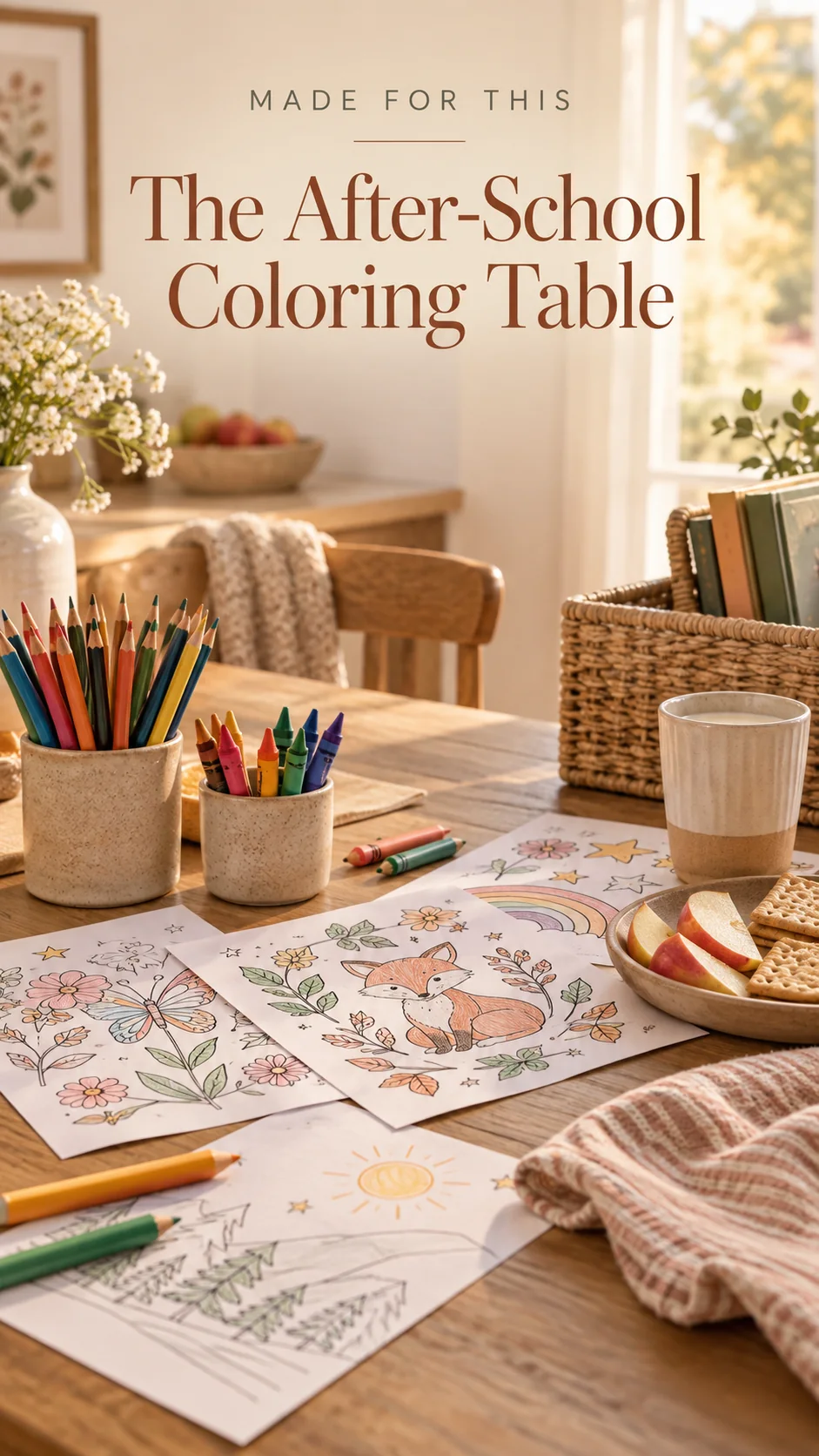
The After-School Coloring Table: A 25-Minute Family Reset That Makes Room for Connection
The Hour Between School and Evening
The after-school stretch can feel deceptively short. Backpacks land, someone needs a snack, another person is looking for a charger, dinner is already becoming a question, and adults are often trying to finish the last pieces of work while switching into family mode. Instead of treating that transition like another problem to optimize, try giving it one small landing place: a coloring table.
The idea is simple. Put a few pages, crayons or colored pencils, and something to drink on the table. Sit down together for about twenty-five minutes with no pressure to produce anything impressive. Coloring is only the doorway; the real purpose is to create a predictable pocket of time where hands are busy, screens are out of the way, and conversation can arrive naturally instead of being forced.
Why This Kind of Pause Can Work
Children often talk more freely when they are doing something beside an adult instead of sitting across from them for a formal conversation. A shared creative activity gives everyone something to focus on while still leaving room for small comments, jokes, questions, and quiet. The American Academy of Pediatrics encourages making space for creativity and notes that screens can distract during play, while the Center on the Developing Child at Harvard emphasizes the value of responsive, back-and-forth “serve and return” interactions between children and caring adults.
That does not mean every coloring session needs to become a deep conversation. Some days the win is simply sitting near each other. A child may tell you everything about school, or they may say almost nothing and spend the whole time choosing between blue and green. Both can belong in the ritual.
Set Up the Table So It Actually Gets Used
The best family routines remove friction. Keep the supplies together in one shallow bin or basket so setup takes less than a minute. Include crayons, washable markers, colored pencils, a few printed coloring pages, and several pieces of blank paper for anyone who wants to doodle instead of staying inside the lines. If younger children are joining, choose age-appropriate supplies and supervise anything that could become a choking or injury hazard.
Try not to make the table look like a craft-store display. Too many options can turn a calm activity into another decision-making project. A small rotation works better: animals one week, vehicles the next, simple patterns, seasonal pages, family-themed drawings, or blank “finish the picture” prompts. The National Association for the Education of Young Children encourages open-ended art experiences where children can make choices and use their imaginations, so leave room for kids to change the page, add a background, invent a story, or ignore the original design completely.
A 25-Minute Flow for Real Weekdays
For the first five minutes, let everyone arrive. Put bags away, wash hands, grab a snack, and choose a page. Adults should choose something too. When the grown-up is participating instead of supervising, the table feels more like shared time and less like an assignment.
Use the middle fifteen minutes for quiet coloring and low-pressure conversation. Skip the rapid-fire “How was school?” interview if it usually gets a one-word answer. Notice what is already happening instead: “That is a serious amount of purple,” “You gave that dog sunglasses,” or “I like the pattern you made.” Those observations create openings without demanding a response.
Use the last five minutes to close the activity instead of letting it drift into the rest of the evening. Each person can show one favorite detail, leave unfinished pages in the basket for tomorrow, and help return supplies. The ending matters because a repeatable ritual works best when everyone knows roughly when it begins and when it is done.
Talk Less, Notice More
One of the easiest ways to make a creative family activity feel stressful is to turn it into a lesson. Resist correcting color choices, fixing uneven lines, or showing a child the “right” way to complete the picture. If the goal is connection, curiosity is more useful than evaluation.
For younger children, simple comments can build language: name a color, shape, animal, or action they are already noticing. For older children and teens, let the activity become background space. They may draw, shade, write lyrics in the margins, or just sit nearby while doing homework. The ritual can grow with the family instead of being reserved for little kids.
Make It Easy Enough to Repeat
The magic is not in the coloring page. It is in the repetition. A fancy one-time craft can be wonderful, but a basket that lives on the shelf and comes out three afternoons a week has a different kind of value. It creates a familiar signal that the school day is ending and the household is shifting gears.
Keep expectations low. Miss a day without guilt. Replace finished pages when the stack gets thin. Let children help choose the next theme. If twenty-five minutes is too long, start with ten. If the table is chaotic, move the ritual to the floor, porch, or kitchen island. The best version is the one your family will actually use.
PRACTICAL TAKEAWAY
Create one small coloring basket tonight: 10–15 pages, blank paper, crayons or pencils, and a simple storage spot. Tomorrow after school, set a 25-minute timer and join the activity yourself. Aim for presence, not perfect art and not a perfect conversation.
CALL TO ACTION
Try the After-School Coloring Table once this week. If your family likes it, keep the basket ready and let each person choose one future theme. Over time, the pages may become less important than what the ritual gives you: a reliable little place to reconnect before the evening gets busy again.
SOURCES
American Academy of Pediatrics / HealthyChildren.org — “5 Play Tips for Preschool-Age Children”: https://www.healthychildren.org/English/family-life/power-of-play/Pages/play-tips-for-preschool-age-children.aspx
Center on the Developing Child at Harvard University — “Serve and Return”: https://developingchild.harvard.edu/key-concept/serve-and-return/
Center on the Developing Child at Harvard University — “Brain-Building Through Play”: https://developingchild.harvard.edu/resources/handouts-tools/brainbuildingthroughplay/
NAEYC — “WOYC Daily Themes / Artsy Thursday”: https://www.naeyc.org/events/woyc/daily-themes